

Your squat has been 315 for six weeks. Your bench has been stuck at 225 for eight weeks. You're adding weight to the bar, missing reps, then backing off.
You're spinning your wheels. This is the most frustrating part of lifting—not the grind, but the standstill. Here's what's important to know: this plateau isn't random.
It's a signal. Your body is telling you something needs to change. You've adapted to your current stimulus.
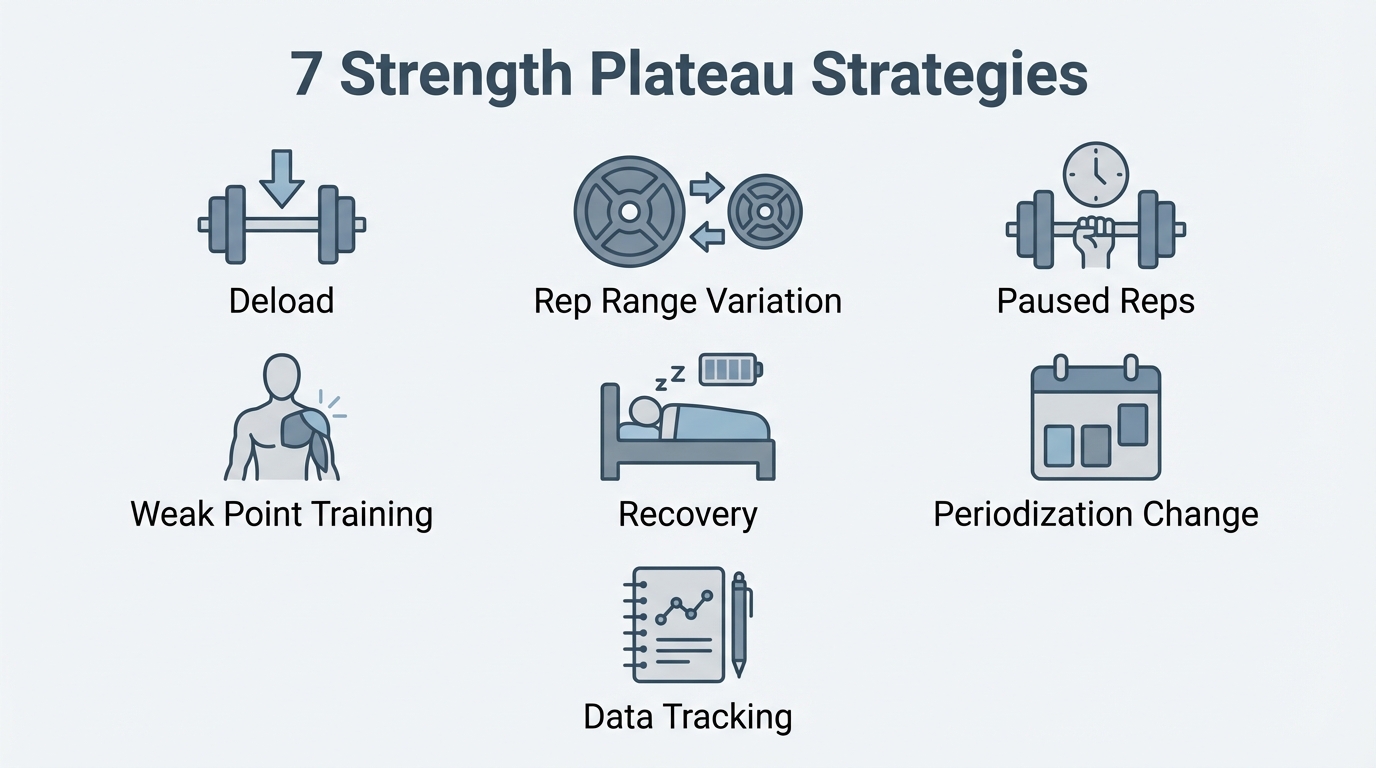
Here are seven strategies that actually work.
Strategy 1: Strategic Deload (The Reset Button)
You've been accumulating fatigue for weeks. You feel it—your joints hurt, your motivation is low, your lifts aren't moving. A deload week fixes this.
Reduce volume by 40-60% for one week while maintaining intensity. If you normally do 4x5 at 85%, do 2x3 at 85%. If you normally do 5x8 at 70%, do 2x5 at 70%.
You're not unloading completely—that's a detraining phase. You're just reducing stress. This allows: Central nervous system recovery, joint recovery, hormonal rebalancing (cortisol drops, testosterone stabilizes), connective tissue repair.
When you return to regular training after deload, you often come back 5-10% stronger. Real example: Jake had been grinding heavy squats for 8 weeks straight.
His max was stuck at 405. His knees hurt. He was tired.
He took one deload week—2x2 at 365. Did some light leg extensions. Mobility work.
The following week he came back to 405 and crushed it for 3 reps. Same weight, different outcome. Deload worked.
Strategy 2: Vary Your Rep Ranges (Shock the Nervous System)
If you've been doing 5x5 for 12 weeks, your nervous system knows exactly what's coming. It's adapted. Your muscles are adapted.
Nothing is difficult anymore. Change the rep range. If you were doing 5x5 at 80%, try: 3x8 at 75% for 2 weeks (volume, work capacity).
Then 6x2 at 88% for 2 weeks (maximal strength, neural drive). Then 4x4 at 82% for 2 weeks (a middle ground). Different rep ranges stress your system differently.
Low reps (1-5): Maximal strength, nervous system recruitment. Medium reps (6-12): Hypertrophy, metabolic stress.
High reps (13+): Work capacity, muscular endurance. Cycling through these creates complete strength adaptation. You're not just strong in one rep range.
You're strong everywhere. This is how people set PRs—they come back to heavy singles after weeks of volume work and realize they're much stronger than they were.
Strategy 3: Add Paused Reps (Eliminate the Reflex)
Paused reps are simple: pause 2-3 seconds in the hardest position, then drive out. For squats: pause 2-3 seconds in the hole, then drive up.
For bench: pause 2-3 seconds at chest, then press up. For deadlifts: pause 2-3 seconds off the floor, then finish the pull.
Why? The stretch reflex helps you out of the hole or off your chest. Pause reps eliminate that.
Your muscles have to generate force without momentum. This builds strength from weak positions. Real benefit: when you go back to regular reps (without pauses), they feel easier.
Your weak position is no longer weak. Start with 70-80% of your normal working weight. A lifter benching 225x5 would try 185x5 with pauses.
Looks easy until that pause hits. Then it's brutal. But it works.
After 3 weeks of paused reps, he came back to 225 and crushed it faster than before.
Strategy 4: Address Weak Points (Attack the Sticking Point)
Your chain is only as strong as its weakest link. Identify where you're weakest: Weak out of the hole on squat?
Your quads are lagging. Weak off the chest on bench? Your chest is weak or your triceps are underdeveloped.
Weak lockout on deadlift? Your back isn't strong enough. Weak off the floor on deadlift?
Your legs and back aren't working together. Once you identify the weak point, you attack it with targeted accessories. Weak squat out of hole: Add front squats (4x6-8) and pause squats (3x5) twice per week.
Your quads will improve in 3-4 weeks. Weak bench lockout: Add pin presses (board presses where pins stop the bar mid-rep), close-grip benches, and overhead presses.
Your triceps and shoulders will improve. Weak deadlift off floor: Add deficit deadlifts (pull from 2-3 inches elevated) and trap bar deadlifts.
Your explosiveness and leg drive improves. Real timeline: A lifter struggled to lock out 275 on bench.
We identified weak triceps. He added close-grip bench and dips twice per week. 4 weeks later: 285 bench.
The weak point fix translated directly to the main lift.
Strategy 5: Fix Your Recovery (Often the Real Problem)
This is the one most people ignore: you can't out-train bad recovery. Your body doesn't grow in the gym. It grows when you're sleeping, eating, recovering.
Three factors: Sleep. You need 7-9 hours per night. Growth hormone peaks during sleep.
Muscle protein synthesis is highest during sleep. If you're sleeping 6 hours and training hard, your body can't recover. You're fighting a losing battle.
Real solution: sleep more. Track it for a week. If you're averaging 6.
5 hours, that's your problem. Protein intake. You need 0.
7-1g per pound of bodyweight daily. If you weigh 200 lbs, that's 140-200g of protein daily. Most lifters don't hit this.
They eat 80g of protein and wonder why they're not building muscle. Real solution: eat more protein.
Eggs, chicken, beef, Greek yogurt, whey powder. Get your protein. Stress management.
Cortisol is catabolic. High stress ruins progress. If you're stressed at work, stressed about money, stressed about life—your body can't prioritize muscle growth.
It's in survival mode. Real solution: manage stress.
Exercise helps. Sleep helps. Time in nature helps.
Whatever works for you. Real example: Tom was plateaued.
He slept 6 hours, ate 80g protein, was stressed as hell. His lifts hadn't moved in 10 weeks. We addressed recovery: he started sleeping 8 hours (put phone away), ate 150g protein, took walks daily.
2 weeks later: PR on squat. It wasn't the program. It was recovery.
Strategy 6: Change Your Periodization Model (Different Stimulus)
If you've been on linear progression (adding 5 lbs every week) and hit a wall, that model has done its job. Your nervous system has adapted. Time to switch.
Try undulating periodization for 4 weeks: Monday: 3x2 at 90% (heavy). Wednesday: 4x8 at 70% (volume).
Friday: 5x3 at 80% (speed). The variety wakes your nervous system back up. Or try block periodization: 4 weeks of 4x10, 4 weeks of 4x6, 4 weeks of 3x3.
Sometimes the plateau isn't that you're weak. It's that your nervous system got bored. Change the stimulus.
Your lifts move again.
Strategy 7: Track Your Data Obsessively (Let Numbers Guide You)
Most lifters rely on feelings: 'I feel strong' or 'I feel tired. ' Feelings are useful but unreliable. Track: Weight, reps, RPE every single session.
Notice patterns. If your bench has been 225x5 at RPE 8 for 3 weeks, but now it's 225x5 at RPE 9, something changed. You're getting fatigued.
Maybe you need a deload. Maybe you need more recovery. Maybe your sleep is bad.
If you track RPE and see it climbing despite stable weight and reps, that's a signal. Real example: A lifter tracked RPE.
His squat stayed 315x5 but RPE went from 7 to 8 to 9 over three weeks. He didn't need to add weight. He needed to deload.
He took one week off-volume. Came back to 315x5 at RPE 7. Problem solved.
The data showed him what was really happening.
The Biggest Mistake (And How to Avoid It)
Most lifters try all seven strategies at once. They deload, change their rep range, add paused reps, switch exercises, fix their sleep, switch their program, and start tracking obsessively—all in one week. Then they get confused about what actually worked.
Do one thing at a time. Commit for 2-3 weeks. If it doesn't work, move to the next.
Real progression: Week 1-3: Deload. Week 4-7: Try undulating for 4 weeks.
Week 8-11: Try pause reps for 4 weeks. Week 12: Take another deload.
This systematic approach lets you identify what actually works for your body, not just what works in theory.
Bottom Line: Plateaus Are Fixable
Your plateau isn't permanent. It's a signal your body needs something different. Could be deload.
Could be rep range variation. Could be weak point training. Could be better recovery.
Could be program change. It's almost never that you're genetically limited—it's that your stimulus has become predictable. Change something.
Your lifts will move.
Break Plateaus With Intelligent Structure — Tsunami Barbell
Plateaus aren’t failure.
They’re feedback.
Tsunami Barbell uses performance data to detect stagnation patterns — rising RPE, stalled volume, inconsistent recovery — and adjusts training variables before frustration sets in.
Instead of guessing whether you need more volume, less volume, heavier work, or recovery, the system adapts stimulus intelligently.
Deloads aren’t random.
Rep ranges aren’t accidental.
Weak-point work isn’t guesswork.
Breakthroughs happen when stimulus evolves.
Strength isn’t linear.
Your program shouldn’t be either.
Frequently Asked Questions About Strength Plateaus
Why do strength plateaus happen?
Plateaus usually occur because your body has fully adapted to a predictable stimulus. Without variation in volume, intensity, or exercise selection, progress slows.
How long should a plateau last before I change something?
If progress stalls for 2–3 weeks despite consistent effort and recovery, it’s time to adjust variables strategically.
Is a plateau always a recovery issue?
Not always. It can be accumulated fatigue, insufficient variation, weak-point limitations, or poor sleep and nutrition.
Recovery is common — but not the only factor.
Should I deload immediately when I plateau?
If RPE is rising and joints feel beat up, yes. If you feel fresh but stagnant, try rep variation or weak-point training first.
Can paused reps really increase max strength?
Yes. Paused reps strengthen weak positions and reduce reliance on stretch reflex. When returning to regular reps, bar speed and control often improve significantly.
Is tracking RPE necessary?
It’s not mandatory, but it dramatically improves decision-making. Rising RPE at the same load is often an early fatigue signal.
Tsunami Barbell
Evidence-based strength coaching and programming for athletes who want real progress.