

You've been training hard for five weeks. Your lifts are moving. But you're starting to feel it—your joints ache, you're not sleeping well, your mood is irritable, and your motivation to train is gone.
Everything feels heavier than it should. You think you need to train *harder* to push through. Wrong.
You need a deload week. This isn't a vacation. This isn't weakness.
This is strategy.
What Exactly Is a Deload Week?
A deload week is intentionally reducing your training volume by 40-60% for one week while maintaining intensity (weight stays high, just fewer sets/reps). Example: Normal week is 5 sets x 5 reps at 80%.
Deload week is 2 sets x 3 reps at 80%. You're still lifting heavy. You're just not doing as much.
The goal is: Central nervous system recovery (your nervous system is tired from weeks of heavy training). Joint recovery (tendons, ligaments, cartilage need breaks). Hormonal rebalancing (cortisol drops, testosterone stabilizes).
Connective tissue repair (microscopic damage accumulates; deload gives time to repair). Motivation restoration (you come back *hungry*). When you return from deload, you're almost always stronger than you were before.
This is called supercompensation.
Why Your CNS Gets Tired (The Science Part)
Your central nervous system (brain, spinal cord) controls muscle recruitment. Every heavy lift demands maximal neural drive. You're sending signals to recruit as many muscle fibers as possible.
After 4-6 weeks of this, your nervous system is fatigued. It can't keep firing at max capacity. You might be physically able to handle 315x5 on squat, but your CNS is too tired to recruit the muscle fibers needed to do it safely or effectively.
This isn't laziness. This is physiology. Accumulated fatigue masks your true strength.
A deload week drops this fatigue. Your nervous system recovers. Your body releases inhibition.
When you come back, you can recruit more effectively. You're stronger. Real example: A lifter doing heavy squats every week for 6 weeks.
Week 1: 315x5 at RPE 8 (feels heavy, grinds). Week 2: 315x5 at RPE 8.
5 (same weight, harder effort). Week 3: 315x5 at RPE 9 (same weight, much harder).
Week 4-6: 315x5 is now at RPE 9+ (barely making it). His CNS is cooked. He takes a deload week (2x3 at 315).
Rests. Sleeps more. Comes back and hits 315x5 at RPE 8 (easier than week 1).
His true strength didn't change. His nervous system recovered.
How to Structure a Deload Week (The Practical Guide)
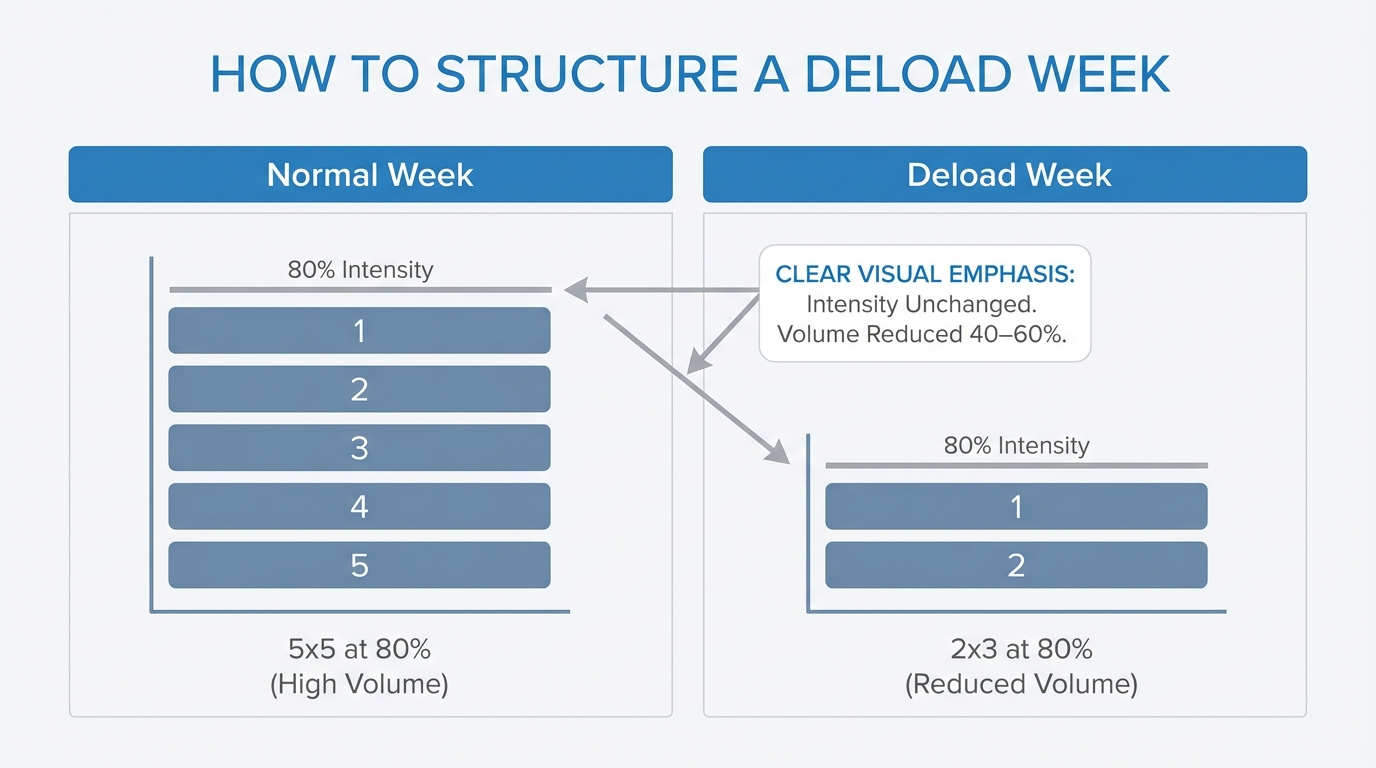
VOLUME REDUCTION: Cut volume by 40-60%. If your normal week is 20 total sets of main lift work, your deload is 8-12 sets. If normal is 40 total weekly sets across all lifts, deload is 16-24 sets. You're maintaining frequency (still training 3-4 days) but reducing tonnage.
MAINTAIN INTENSITY: This is critical. Don't lower the weight. If your working sets are usually at 80-85%, they should still be at 80-85% during deload. The difference is just fewer sets/reps. Example: Normal week is 5x5 at 80%. Deload week is 2x3 at 80%. Same weight, fewer reps.
REDUCE ACCESSORIES: Accessories get hit hardest. Normal week has 3-4 accessory exercises? Deload has 1-2. Normal week has 3 sets per accessory? Deload has 1-2 sets per accessory.
ADD QUALITY WORK: Use deload for mobility, prehab, technique refinement. This is when you fix form issues, stretch, get massage, take ice baths. Your body needs recovery, not just rest.
FOCUS ON SLEEP & NUTRITION: This is the week to sleep 8-9 hours, eat well, manage stress. You're prioritizing recovery systems.
Real Deload Example (For Powerlifter Training 4 Days)
Normal week for a 1,100 lb total (375 squat, 275 bench, 450 deadlift) lifter: Monday: Squat 5x5 at 310 (83%), 3x8 leg press, 3x8 leg curl. Wednesday: Bench 4x5 at 225 (82%), 3x8 incline bench, 3x8 tricep dips.
Friday: Deadlift 3x3 at 385 (85%), 3x5 rows, 3x8 leg extension. Saturday: Squat 3x3 at 325 (87%) high bar, 3x8 GHD sit-ups.
Total volume: ~50 sets. Intensity: 82-87%.
Deload week: Monday: Squat 2x3 at 310, 1x5 leg press. Wednesday: Bench 2x3 at 225, 1x5 incline bench.
Friday: Deadlift 2x2 at 385, 1x5 rows. Saturday: Light mobility work, stretching, walking.
Total volume: ~15 sets. Same intensity, 70% less volume. The lifter still trains, maintains neural drive, but drops fatigue dramatically.
When to Deload (Signs You Need One)
You've been training hard for 4-6 weeks without a break. Most people should deload every 4-6 weeks regardless of how they feel.
Your lifts plateau for 2+ weeks despite good effort and recovery. This often means accumulated fatigue masking strength.
Your RPE is climbing. Same weight and reps but RPE went from 7 to 9 in a few weeks. Your system is tired.
Your motivation is gone. You dread going to the gym. Your system is begging for a break.
Your joints hurt (not sharp pain—just general achiness). Tendons need recovery time.
Your sleep quality dropped or your mood changed. Overtraining affects your entire system.
You're getting sick frequently. Overtraining suppresses immune function.
Common Deload Mistakes (How to Avoid Them)
DELOADING TOO HARD: Cutting weight to 50% and doing 1x5 is detraining, not deloading. You want to maintain the neural pattern. Keep intensity high (80-85%), just reduce volume.
DELOADING TOO LONG: One week is usually perfect. Two weeks can actually make you weaker. You're maintaining in one week. Two weeks and you start detraining.
DELOADING WRONG EXERCISES: Don't deload everything equally. Your main lifts get volume reduction but maintain intensity. Accessories get hit harder (maybe skip them). Conditioning can stay normal.
IGNORING THE RECOVERY OPPORTUNITY: If you deload but still sleep 6 hours, eat poorly, and stress out—the deload is 50% effective. Use the week to actually recover.
COMING BACK TOO HARD: After deload, don't jump right back to 100%. Start at 90-95% of previous workload. Build back in.
The Truth About Supercompensation
After your deload week, something magical happens. You come back and lifts feel *easy*. Your strength is up.
Your motivation is back. Your joints feel better. This is supercompensation.
Your nervous system, muscles, and connective tissues have fully recovered. They've adapted to the training stimulus and come back stronger. This isn't luck.
This is physiology. Your body wants to adapt. After 4-6 weeks of stimulus, it adapts.
Then you remove stress with deload. Your body responds by *overcompensating*—becoming stronger than before the stress. This is why deloads work.
They're not a break from progress. They're part of progress.
Deload Schedule (How Often?)
Standard recommendation: one deload week every 4-6 weeks. A typical year of training: Weeks 1-4: Normal training.
Week 5: Deload. Weeks 6-9: Normal training.
Week 10: Deload. Weeks 11-14: Normal training.
Week 15: Deload. Weeks 16-19: Normal training.
Week 20: Deload. Then repeat. Some lifters need more frequent deloads (every 3-4 weeks).
Some can go 6-8 weeks without issue. The key: listen to your body.
If your RPE is climbing and your mood is bad, don't wait for week 6. Deload at week 4. The schedule is a guideline, not a rule.
Bottom Line: Deloads Aren't Lazy
Deloads are how serious lifters keep progressing long-term. They're not a break from training. They're a strategic part of training.
Embrace them. Your body will thank you with better performance when you come back.
Recovery Is Part of the System — Tsunami Barbell Approach
Most lifters think progress comes from pushing harder.
In reality, progress comes from managing fatigue.
Tsunami Barbell integrates structured deload logic into training cycles. Instead of waiting until you're burned out, the system anticipates accumulated fatigue and adjusts volume strategically — while maintaining intensity to preserve neural strength.
Recovery isn’t a break from progress.
It’s how progress becomes sustainable.
Supercompensation isn’t random.
It’s earned through intelligent stress — and intelligent reduction of stress.
Train hard. Recover harder. Progress longer.
Frequently Asked Questions About Deload Weeks
What is the purpose of a deload week?
A deload reduces accumulated fatigue while maintaining strength adaptations. It allows your nervous system, joints, and connective tissues to recover so performance can rebound.
Should I lower the weight during a deload?
Generally, no. Keep intensity (80–85% of your working weight) but reduce total volume by 40–60%.
Lowering weight too much risks detraining instead of recovering.
How often should I deload?
Most lifters benefit from a deload every 4–6 weeks. Advanced lifters training at high intensity may need one every 3–4 weeks.
Will I lose strength during a deload?
No. One week of reduced volume does not cause strength loss. In most cases, strength improves due to reduced fatigue.
What are signs I need a deload?
Rising RPE for the same weights
Persistent joint aches
Poor sleep
Mood changes
Plateauing lifts
Loss of motivation
Is a deload the same as taking a week off?
No. A deload maintains intensity and training frequency. It’s controlled recovery, not complete rest.
Tsunami Barbell
Evidence-based strength coaching and programming for athletes who want real progress.