

Watch two lifters squat the same weight. One moves with control, stays upright, comes out of the hole explosively. The other rounds forward, knees cave inward, barely makes it.
Same weight. Completely different experiences. The difference?
Technique. Good technique lets you lift heavier, stay healthier, and progress faster. Bad technique limits your strength, hurts your joints, and creates bad habits.
These eight cues fix technique. Use them.
Cue 1: Chest Up (Proud Posture)
This is the first thing to establish before you even descend. Take a breath, set your feet, and create tension in your upper back. Cue for yourself: 'Puff out your chest' or 'Be proud'—literally imagine your chest out.
Why? A neutral spine (straight from tailbone to head) creates mechanical advantage. Your muscles are stronger when your spine is neutral.
Your back stays safe. Common mistake: Your chest falls forward during the descent.
Your torso collapses. Your knees track forward excessively. Your squat turns into a knee-dominant disaster.
Real cue: Before you move, feel your chest out. During the descent, actively maintain that chest position. Think 'ribs down' (don't flare ribs) but 'chest up' (maintain the angle).
After fixing chest position, most lifters immediately get stronger and feel better. One lifter was squatting 275 and frustrated. His chest was collapsing.
We cued chest up for two sessions. Week three he hit 295 for reps. The weight was there.
The technique wasn't.
Cue 2: Knees Out (External Rotation)
Your knees should track over your toes throughout the entire squat. Cue: 'Push your knees outward' or 'Spread the floor.
' Imagine you're pushing the ground away with the outside of your feet. Why? When knees cave inward (valgus collapse), you lose torque generation and you stress the ACL (anterior cruciate ligament).
Your quadriceps are also weaker in valgus position. Common mistake: Knees cave inward, especially coming out of the bottom.
This is often weak glutes or weak external rotators. The cue sometimes helps. But if the problem persists, you need accessory work: clamshells, band pull-aparts, hip external rotation work.
Real progression: A female lifter kept caving her knees. We cued 'knees out' but it wasn't sticking. She did 3 weeks of hip thrusts with focus on glute activation, band external rotation, and box squats where she really focused on pushing knees out.
After 3 weeks, the valgus collapse was gone. The cue alone wasn't enough. The accessory work fixed it.
Cue 3: Stay Over Your Midfoot (The Foundation)
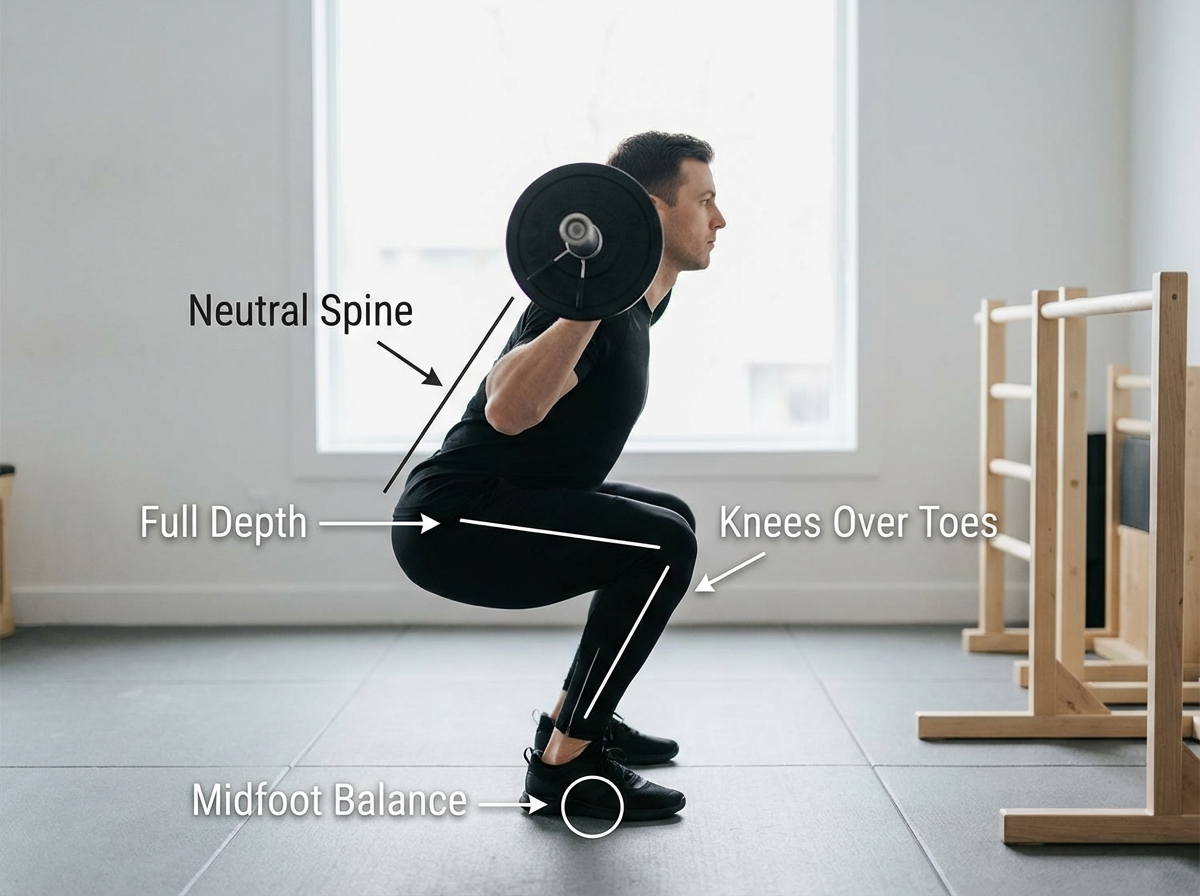
Throughout the descent and ascent, your weight should stay over your midfoot. Not toes. Not heels.
Midfoot. Cue: 'Feel your weight in your whole foot' or 'Midfoot pressure.
' The bar path should be vertical. Weight should feel distributed across your whole foot. Why?
Over toes = your heels come up, loses leg drive, you turn into a knee-squat. Over heels = you sit back too far, lose quad involvement, become quad weak. Midfoot = balanced leg drive, quads and glutes work together.
Common mistake: Heels coming up. This usually means: (A) ankle mobility issue, (B) leaning too far forward, (C) not engaging glutes.
Real fix: Work ankle mobility (wall squats, banded ankle mobilization). Focus on driving through whole foot. Get in the bottom position and feel where your weight is.
Most lifters can fix this with one session of conscious attention.
Cue 4: Achieve Full Depth (Hip Crease Below Parallel)
Competitive powerlifting standard: hip crease below parallel (the crease between your hip and thigh dips below the plane of your knee). Cue: 'Go to depth' or 'Hip crease below parallel.
' Why does depth matter? Shallow squats (quarter squats) train partial range of motion. You develop strength in a limited range.
You miss muscle activation in the deep range. Real squats—full-depth squats—recruit more muscle, build more strength everywhere. Common mistake: Stopping high because you're not strong at the bottom or mobility is limited.
Real solutions: If you're not strong at the bottom, do paused squats and tempo work (2-3 second descents). If it's mobility, do mobility work (stretching, foam rolling, pigeon pose). Most lifters can add depth once they address mobility or weakness.
Cue 5: Neutral Neck (Eyes Forward)
Don't look excessively up. Don't look down. Keep your head in line with your spine.
Cue: 'Eyes forward' or 'Keep your head neutral. ' Why? Excessive neck extension (looking up hard) or flexion (looking down hard) creates cervical spine stress.
You're already under tension with weight on your back. You don't need to add neck stress. Common mistake: Looking up intensely to 'drive' out of the bottom.
This doesn't help. It adds unnecessary stress. Real cue: Keep your eyes forward or slightly up, but not exaggerated.
Your neck follows your spine.
Cue 6: Core Bracing (Brace Hard)
Before you descend, take a full breath and brace your core like you're about to take a punch. Cue: 'Hold your breath' or 'Brace your core.
' Your core creates intra-abdominal pressure (IAP) which stiffens your spine and increases squat strength by 10-15%. This is measurable. Common mistake: Not bracing or bracing weakly.
You lose the benefit. You're unstable at the bottom. Real process: Breath in fully (belly and chest), brace all core muscles (abs, obliques, back extensors), hold that tension throughout the squat.
Exhale after you stand up. Practice for one week and you'll feel the difference. The same weight feels easier when you're braced versus when you're not.
Cue 7: Elbows High, Wrists Neutral (Upper Body Setup)
Your elbows should stay high and slightly forward. Your wrists should be neutral (not bent back excessively). Cue: 'Elbows high' or 'Wrists straight.
' Why? High elbows keep tension in your upper back. They prevent forward rounding.
Neutral wrists prevent wrist pain and maintain upper back tension. Common mistake: Elbows dropping (lose upper back tension), or wrists bent backward excessively (wrist pain).
Real fix: Cue elbows high. Squeeze your upper back. Wrists should feel neutral—not bent.
Some lifters naturally have wrist mobility that allows bent wrists. That's fine if it doesn't hurt. But neutral is safer.
Cue 8: Drive Through Whole Foot (The Ascent)
As you drive out of the bottom, engage your entire foot—heels, midfoot, toes. Cue: 'Drive through your whole foot' or 'Glutes and quads together.
' Why? This ensures balanced leg drive. You're not just extending knees (quad-only).
You're not just driving hips (glute-only). You're using both. Common mistake: Driving with just quads or just glutes.
Quad-only = heels come up. Glute-only = you sit back too far. Together = balanced strength.
Real cue: Feel pressure through your entire foot as you drive up. Both quads and glutes work simultaneously.
Progression: Building from Bad Form to Good Form
Don't try to fix everything at once. Here's a real progression: Week 1-2: Chest up + knees out (two things).
Get comfortable. Week 3-4: Add midfoot position + depth.
Now four things. Week 5: Add core bracing.
Five things. Week 6: Add elbows high + neck position.
Seven things. Week 7: Add drive ascent.
Eight things. By week 7-8, all eight cues are automatic. Real example: A lifter had terrible form.
Chest collapsing, knees caving, heels coming up, shallow depth. We spent week 1 on just chest and knees. Form improved immediately.
He was stronger already. Week 2 we added depth focus. Week 3 we added bracing.
By week 4 his form was solid. His squat went from 275 (bad form) to 305 (good form) just from technique improvement. No strength gain.
Just technique.
The Real Power of Good Form
Good form isn't just about looking good. It's about: Getting stronger faster (good form = better force production).
Staying healthy (reduces injury risk). Feeling better (joints hurt less). Making progress (you can actually lift heavier).
Most plateaus aren't strength plateaus. They're form plateaus. You've hit the limit of what your current technique can produce.
Fix technique. Your lifts move.
Bottom Line: Technique is Foundational
Technique is how elite lifters lift heavy and stay healthy for decades. You can be strong with bad form for a little while. But you'll plateau.
You'll get injured. Fix technique first. Strength follows.
Training Smarter With Tsunami Barbell
Perfect technique isn’t about memorizing cues.
It’s about reinforcing them consistently — under load, across weeks, when fatigue sets in.
Tsunami Barbell integrates technique-focused programming with intelligent load management. Instead of blindly increasing weight, the system adjusts volume and intensity based on real performance — so technique doesn’t break down under stress.
Good form isn’t random.
It’s trained, reinforced, and protected.
Elite lifters don’t just lift heavy.
They lift well — consistently.
Technique + intelligent progression is what builds long-term strength.
Frequently Asked Questions About Squat Technique
What is the most important squat cue?
There isn’t one single cue for everyone. However, maintaining a neutral spine and balanced midfoot pressure are foundational. If those two are correct, most other issues become easier to fix.
Should my knees go past my toes in a squat?
Yes — in most lifters, knees naturally travel past toes. That’s normal and safe. The key is that knees track in line with toes and don’t collapse inward.
Why do my knees cave in when I squat?
Knee valgus often comes from weak glutes or poor external rotation control. Strengthening hip stabilizers and consciously cueing “knees out” typically resolves the issue.
How deep should I squat?
For general strength and muscle development, aim for hip crease below parallel if mobility allows. Full range of motion builds more complete strength.
Is low-bar or high-bar squat better?
Neither is universally better. High-bar emphasizes quads more and keeps a more upright torso. Low-bar allows heavier loads for many lifters. The best choice depends on your goal and leverages.
Why does my chest collapse forward?
This is usually a combination of weak upper back tension, poor bracing, or fatigue. Strengthening the upper back and improving core bracing often fixes it quickly.
Can fixing technique immediately increase strength?
Yes. Many lifters gain 5–15% on their squat simply by improving mechanics and bar path efficiency — without increasing muscle mass.
Tsunami Barbell
Evidence-based strength coaching and programming for athletes who want real progress.