

RPE stands for Rate of Perceived Exertion. But it's more than just a fancy name—it's how elite coaches autoregulate training in real-time. Instead of following a rigid program that says '5x5 at 80%,' you adjust the weight based on how difficult the set actually *feels*.
This is the difference between training by numbers and training by feel (intelligently).
Understanding the RPE Scale (1-10)
RPE is measured 1-10. Here's what each number means: RPE 1-3 is warm-up territory.
You could do 20+ more reps. This is movement practice. RPE 4-5 is easy work.
You could do 10+ more reps. This is work capacity building. RPE 6-7 is moderate.
You could do 5-7 more reps. This is still relatively easy. RPE 8 means you could do 2 more reps.
You're working, but not maxed out. RPE 9 means you could do 1 more rep. This is hard.
RPE 10 is absolutely maximal. Zero reps left in the tank. You physically cannot do another rep.
For most training, you're working in the RPE 6-9 range. RPE 10 is rare—only for max attempts.
Real-World RPE Examples (How It Feels)
Bench press example: You're supposed to do 5 reps at RPE 8. You load 225. You press it.
On the 5th rep, you feel like you could grind out 1-2 more reps but it's definitely hard. That's RPE 8. If 5 reps felt easy and you could do 5-6 more, that's RPE 6-7.
If 5 reps crushed you and you couldn't do even one more, that's RPE 9-10. Another example: Squat sets.
You're doing 5 reps at RPE 7. You load 315. It moves well.
By rep 5, you could do 4-5 more reps pretty easily. That's RPE 7. If you could do 8+ more, that's RPE 5-6.
If you could do only 1-2 more, that's RPE 8-9. The key is: RPE is about how many reps you have left, not how hard the reps *felt*.
It's about reserve capacity.
RPE vs Percentage-Based Training (Why RPE Wins)
Percentage-based training says: 'Do 5x5 at 80% of your max. ' Your max is 400 lbs. 80% is 320 lbs.
You do 5x5 at 320 regardless of how you feel. Pros: Simple, predictable, you know exactly what weight to load.
Cons: Doesn't account for daily variables. If you slept poorly, ate less, had a stressful day—you're still doing 5x5 at 320. You might crush it or you might barely survive.
There's no flexibility. RPE-based training says: 'Do 5 reps at RPE 8.
' You pick a weight that feels appropriately hard for RPE 8. If you feel great (slept well, ate well, low stress), you might do 325 and hit RPE 8. If you feel mediocre (slept 6 hours, ate poorly, stressed), you might do 300 and hit RPE 8.
The RPE is the constant. The weight adjusts. Pros: Accounts for daily recovery variables, always the right stimulus, flexibility for life.
Cons: Requires RPE literacy (you need to understand what RPE 8 feels like).
How to Learn Your RPE (Training Wheels for Beginners)
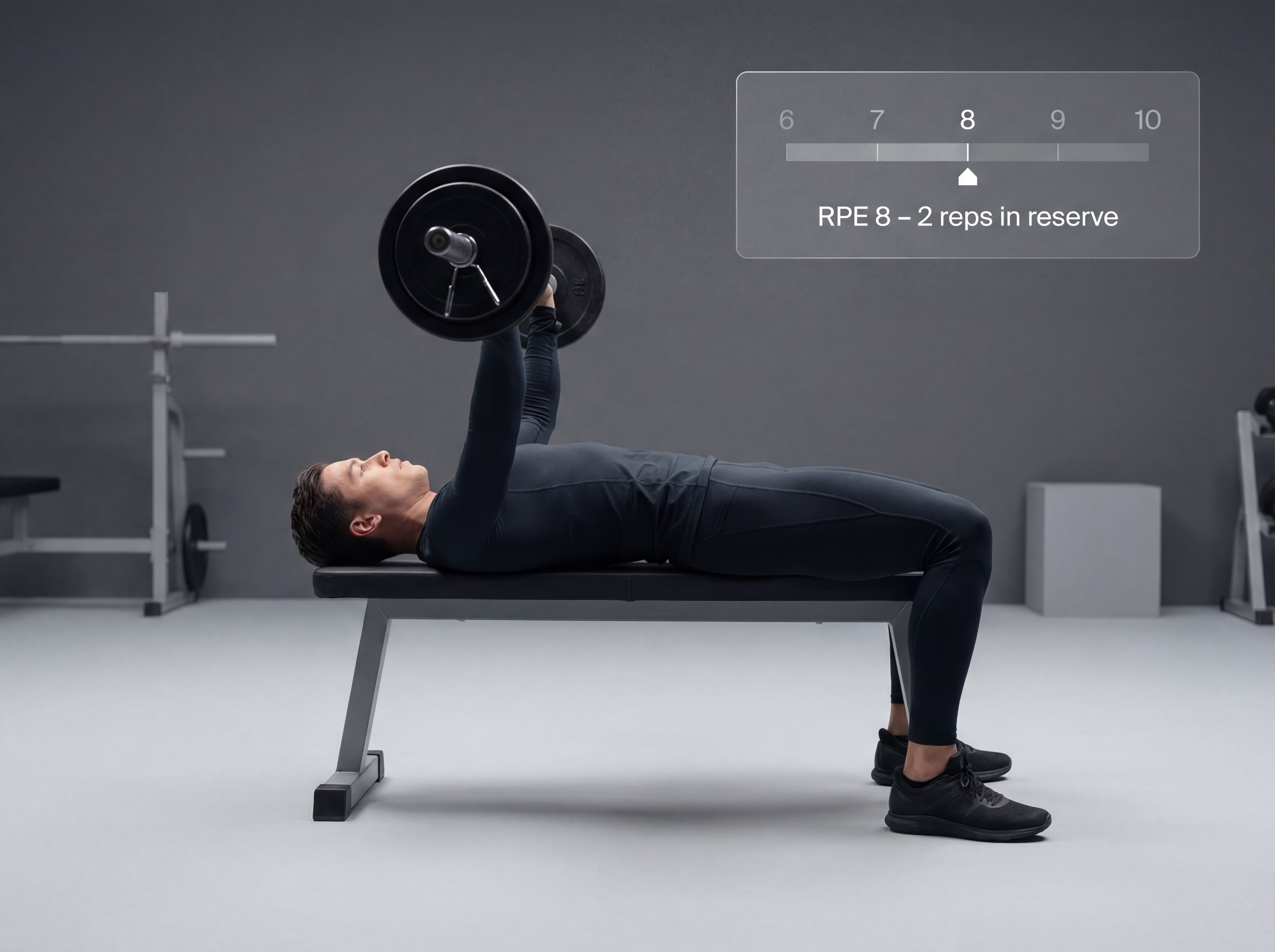
Most lifters don't naturally understand RPE. You need to train it. Start simple: Step 1: Pick a weight.
Do a set. Rate how many reps you could have done. Step 2: Do this for 3-4 weeks.
Try to hit RPE 7-8 on your main lifts. You'll start recognizing the feeling. Step 3: After 2-3 weeks, you'll start predicting.
You'll walk up to the bar and think, 'This should be RPE 8. ' You'll do it and you're right. That's when you know you've learned RPE.
Real example: A beginner starts with bench. Week 1: Does 225x5.
Asks himself, 'Could I do 2 more reps? ' Yes, easily. That's RPE 6.
Week 2: Does 235x5. Could he do 2 more? Yes, but it's harder.
Still RPE 7. Week 3: Does 245x5.
Could he do 2 more? Barely, maybe 1. That's RPE 8.
By week 4, he can walk up and *feel* RPE 8 before even lifting.
Autoregulation in Practice (Real Training)
Program says: Squat 5 reps at RPE 8. Monday you feel great. You hit 325x5 at RPE 8.
Strength is moving. Wednesday you feel flat (slept 6 hours). You hit 300x5 at RPE 8 instead of 325.
Same stimulus, lighter weight. Friday you feel average. You hit 315x5 at RPE 8.
You're always getting the right challenge for your current state. Compare that to percentage-based: You're supposed to do 5x5 at 80% = 320 lbs regardless.
Monday you crush 320x5 (probably RPE 6-7). Wednesday you barely survive 320x5 (probably RPE 9). Friday it feels normal (probably RPE 8).
You're not getting consistent stimulus. You're sometimes undertrained, sometimes overtrained. RPE autoregulation keeps you in the goldilocks zone.
This is why world-class coaches use RPE.
RPE Autoregulation for Different Goals
MAXIMAL STRENGTH (Heavy Singles/Doubles): RPE 8-9. You want to train heavy but not to absolute failure every day. That burns out your CNS. RPE 8-9 gives you heavy stimulus without unnecessary fatigue.
STRENGTH (3-6 Reps): RPE 7-8. You're building strength and muscle together. RPE 7 is productive work. RPE 8 is harder but still sustainable.
HYPERTROPHY (6-12 Reps): RPE 6-8. Lower RPE (6-7) with higher volume. Higher RPE (8) with lower volume. Both build muscle.
WORK CAPACITY (8-15 Reps): RPE 5-7. You're not trying to max out reps. You're doing moderate weights for volume. RPE 5-6 is perfect here.
SPEED/POWER (1-3 Reps, Fast): RPE 5-7. You want speed, not maximum effort. Maximum effort slows you down. RPE 5-6 lets you move explosively.
Real-World Undulating Week Using RPE
Here's how an intermediate lifter structures a week using RPE autoregulation: Monday (Heavy): Squat 3x2 at RPE 8-9 (maximal strength). Some days it's 330, some days it's 340. He adjusts based on feel.
Wednesday (Volume): Squat 4x6 at RPE 6-7 (hypertrophy/work capacity). Some days it's 280, some days it's 295. Light, controlled, focused on volume.
Friday (Speed): Squat 6x2 at RPE 5-6 (speed/power). Some days it's 270, some days it's 280. The emphasis is explosive, not heavy.
Same week: Monday felt good (+340). Wednesday felt mediocre (-270). Friday felt great (+280).
He adjusted weights based on RPE, not a predetermined percentage. He got appropriate stimulus every session. He didn't overtrain on his bad day or undertrain on his good day.
That's autoregulation.
Common RPE Mistakes (How Beginners Mess This Up)
MISUNDERSTANDING RPE: Thinking RPE is about how hard it *feels* rather than reps remaining. It's not. It's literally 'How many more reps could I do?' Feels hard but could do 5 more? That's RPE 5, not RPE 8.
NOT LEARNING RPE FIRST: You can't just jump into RPE autoregulation if you don't understand it. Spend 2-3 weeks learning it. Do sets, assess them after, learn the difference between RPE 6 and RPE 8.
BEING TOO AGGRESSIVE: Always training at RPE 9-10 because you think harder = more gains. You'll burn out. RPE 8 is productive. RPE 9 occasionally. RPE 10 rarely.
BEING TOO CONSERVATIVE: Always training at RPE 5-6 because you're scared to push hard. You won't get strong. You need RPE 7-8 regularly on main lifts.
IGNORING DAILY CONTEXT: A good day should be slightly heavier. A bad day should be slightly lighter. If every day is the same RPE with the same weight, you're not really autoregulating.
Combining RPE With Periodization
The best approach: Use periodization as your structure, RPE as your flexibility. Example: You're in an accumulation block (high volume).
Your target is 4x8-10 at RPE 6-7. But one day you feel great. Instead of doing 4x8 at the planned weight, you do 4x8 at a slightly heavier weight and hit RPE 7 (not RPE 5).
Another day you feel terrible. You do 4x8 at a slightly lighter weight and hit RPE 6 (not RPE 9). The periodization gives you structure (what rep range, how many sets).
RPE gives you flexibility (exact weight, exact challenge). This is how elite programs work.
Bottom Line: RPE is How the Best Train
RPE autoregulation isn't complicated. It's just intelligent training. Instead of following rigid percentages, you adjust based on how your body actually feels.
You're always getting the right stimulus. You don't overtrain on bad days. You don't undertrain on good days.
You progress consistently. Learn RPE. Use it.
Your lifts will thank you.
Training Smarter With Tsunami Barbell
Understanding RPE is the first step toward intelligent training.
The next step is applying it consistently — without guessing.
Tsunami Barbell uses autoregulation principles like RPE to automatically adjust your training loads based on real performance data. Instead of manually estimating how hard a set felt, the system adapts your weekly volume and intensity so you stay in the optimal stimulus zone.
Some days you're stronger. Some days you're not.
The program adjusts — not your discipline.
If you believe in training smart instead of blindly following percentages, you'll understand why autoregulation is the future of strength programming.
RPE is how elite coaches think.
Intelligent adaptation is how modern systems scale that thinking.
Frequently Asked Questions About RPE Autoregulation
Is RPE the same as RIR?
Almost. RPE is built on Reps In Reserve (RIR).
If you could do 2 more reps, that's typically RPE 8.
If you could do 1 more rep, that's RPE 9.
RPE = 10 – RIR (roughly).
Is RPE better than percentage-based training?
It depends on context. Percentage-based training works well when your max is accurate and recovery is consistent.
RPE works better when daily readiness fluctuates — which is true for most lifters. It adjusts intensity to your real-time performance instead of a fixed number.
Should beginners use RPE?
Beginners can use RPE, but they must first learn what different effort levels feel like.
For the first 2–4 weeks, treat RPE as a learning tool. Over time, accuracy improves dramatically.
How accurate is RPE?
Advanced lifters are often within 1 rep of true failure prediction.
Beginners tend to misjudge by 2–3 reps at first. This improves quickly with practice.
Is RPE only for powerlifting?
No. RPE can be used for:
Strength training
Hypertrophy
Speed and power work
General fitness programming
It’s a universal intensity management tool.
How often should I train at RPE 9 or 10?
Rarely.
RPE 10 (true max effort) should be reserved for testing or competition.
Most productive training happens between RPE 6–8.
Tsunami Barbell
Evidence-based strength coaching and programming for athletes who want real progress.