

Your lifts have been stuck for weeks. You're doing the same 5x5 routine that worked great in month two, but now—in month five—you're going nowhere. You add weight, miss reps.
You lower weight, feel bored. Nothing's working. This is where 90% of lifters quit.
But this isn't a lack of effort or genetics. This is accommodation. Your body has adapted to the same stimulus and is no longer responding.
Periodization is how you fix this.
What Periodization Actually Is (Not the Boring Version)
Periodization isn't complicated. It's simply this: instead of doing the same thing every week, you intentionally vary the training to keep forcing your body to adapt.
That's it. But here's why it matters: your nervous system, muscles, and connective tissues are incredibly efficient at adapting to predictable stress.
After 3-4 weeks of 5x5 at 80%, your body figures out the pattern. It becomes automatic. Your strength gains slow to a crawl.
Periodization breaks this cycle by introducing planned variation—changing rep ranges, intensity levels, exercise selection, and training volume in specific patterns to continuously challenge your system and force adaptation.
Why Your Current Program Isn't Working
If you've been grinding the same routine for 8+ weeks without progress, this is the problem. Linear progression (just adding 5 lbs every week) works great for beginners—you've got years of adaptation potential. But after 2-3 months, your nervous system has learned the pattern.
It's like playing the same video game level over and over. Easy at first, then boring. Your body knows exactly how to handle 185x5 at RPE 8.
It's not difficult anymore. So it doesn't grow. Periodization fixes this by ensuring your body never fully adapts.
You're constantly throwing new challenges at it—sometimes heavy singles, sometimes volume reps, sometimes speed work. This constant variation is what keeps your nervous system firing, your muscles growing, and your lifts moving.
Here's the practical reality: elite weightlifters, powerlifters, and strength coaches have been using periodization for 70+ years because it works. The Soviet strength scientists figured this out in the 1950s. It's not a fancy new trend.
It's the foundation of how serious athletes train.
The Three Main Periodization Models (And When to Use Each)
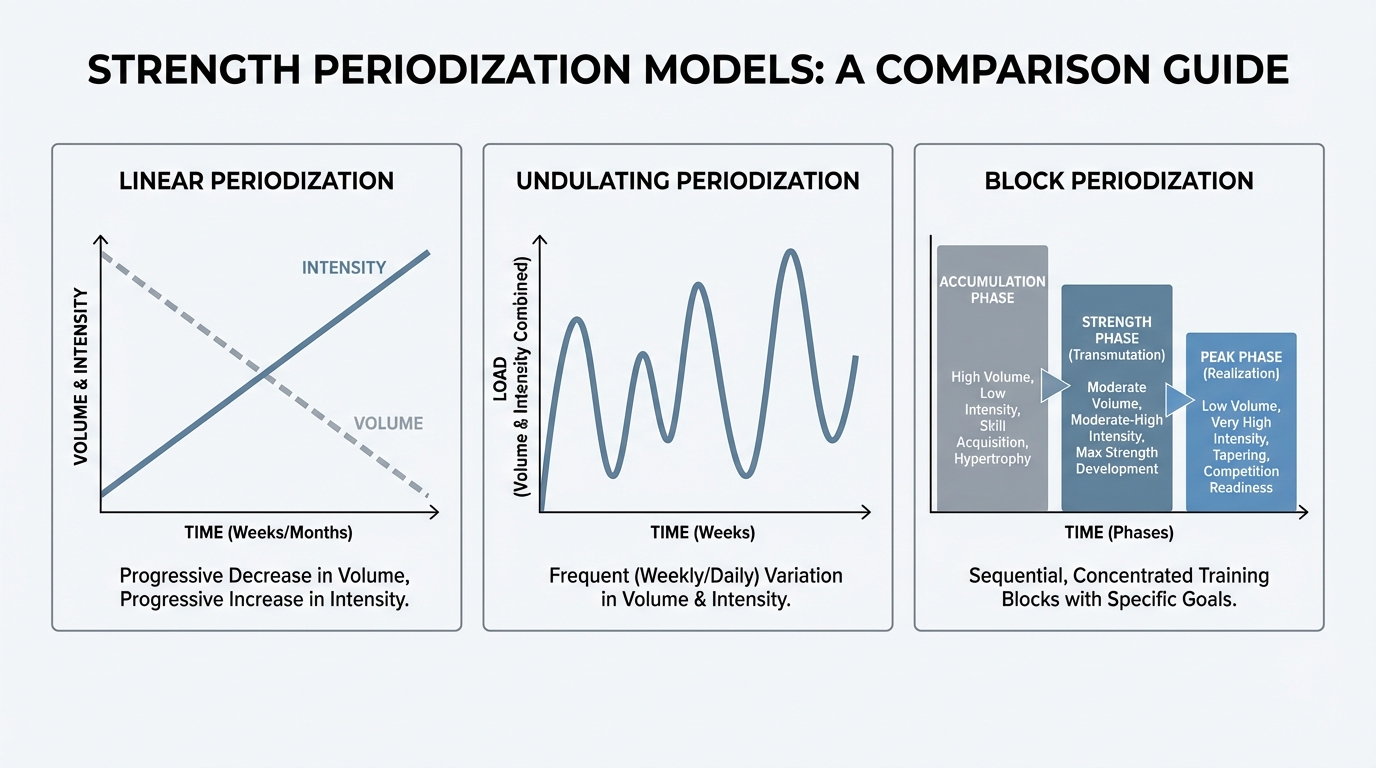
LINEAR PERIODIZATION: Start with high volume at low intensity, gradually decrease volume while increasing intensity. Week 1-4: 4x10 at 65-70%. Week 5-8: 4x6 at 75-80%. Week 9-12: 3x3 at 85-90%. Then peak week at 1-2 reps. Best for: Beginners (less than 2 years training). You need a foundation of muscle mass and work capacity. Linear progression is simple to follow, builds muscle, then builds strength on top of that muscle.
UNDULATING PERIODIZATION: Within each *week*, vary the volume and intensity. Monday: 3x2 at 90% (heavy). Wednesday: 4x8 at 70% (volume). Friday: 5x3 at 80% (speed work). Best for: Intermediate to advanced lifters (2-5+ years). Your nervous system adapts fast. You need frequent variation. You also get to hit heavy lifts every week, which keeps you motivated.
BLOCK PERIODIZATION: Dedicated blocks for specific qualities. Accumulation block (hypertrophy): 3-4 weeks of 3-4 sets x 8-15 reps at 60-75%. Transmutation block (strength): 3-4 weeks of 5-8 sets x 3-6 reps at 75-85%. Realization block (peak): 1-2 weeks of 1-3 reps at 90%+. Best for: Competitive athletes, people preparing for a meet or strength competition. Each block has one focus. You build the foundation, convert it to strength, then maximize it.
The Real Secret Nobody Talks About
Periodization only works if you actually commit to it. And I mean commit. That means: don't ego-lift during high-rep phases.
The point of 4x10 isn't to grind heavy weight. It's to build work capacity and muscle. That's the foundation.
Don't switch programs every 2 weeks because you're bored. Stick with one for at least 8-12 weeks. Give it time to work.
Don't do a 'peak week' every week—there's nothing special about singles if you're always doing singles. The magic is in the *variation*. Once you understand this, periodization becomes less about following rules and more about respecting the process.
Common Mistakes (Learned From Painful Experience)
Deloading too hard. You cut volume to 20% and start wondering why you feel weak. A deload is 40-60% volume reduction at maintained intensity, not a vacation. You still need to lift heavy.
Skipping deloads because you feel strong. This is how you burn out. Even if you feel great, your CNS is tired. Take the deload. You'll be stronger after.
Not tracking anything. 'I think I'm stronger' isn't data. Write down weights, reps, RPE. You need to know if the program is actually working.
Changing exercises every block unnecessarily. You need consistency to measure progress. Squat variations are fine, but bouncing between 5 different squat variations every week is chaos.
Progressing too fast. If you jump 20 lbs every week on a linear program, you'll plateau in 2 weeks and get frustrated. Be patient with increments. Small, consistent progress compounds.
How to Get Started Right Now
Pick one of the three models based on your training age. If you're new (under 2 years): start with linear periodization.
Pick a squat, bench, or deadlift as your main lift. Do 4 weeks of 4x10, 4 weeks of 4x6, 4 weeks of 3x3. Add 5 lbs each week on the main lift.
That's it. After 12 weeks, either run another linear cycle or switch to undulating if you want more variety. If you're intermediate (2-5 years): try undulating.
Pick 2-3 main movements. Hit them each once per week on different rep ranges. You'll maintain heavy strength while also building muscle and work capacity.
If you're advanced or competitive: block periodization is your friend. But honestly, most lifters do best with a mix—block periodization for the main phases, undulating during the off-season. The point is this: stop doing the same thing every week.
Your body will thank you, and your lifts will move again.
The Bottom Line
Plateaus aren't about lack of effort. They're about your body adapting to the same stimulus. Periodization is the fix.
Whether it's linear, undulating, or block, the principle is the same: vary your training in intelligent ways. Build a foundation, increase intensity, peak, recover, repeat. Do that, and you'll break plateaus, set PRs, and never get stuck again.
The lifters who progress consistently aren't the strongest or most talented. They're the ones who understand periodization and actually apply it.
Training With Structure: The Tsunami Barbell Approach
Plateaus don’t happen because you stopped working hard.
They happen because your body adapted.
Tsunami Barbell applies periodization principles automatically — varying volume, intensity, and stimulus across structured training waves. Instead of repeating the same sets and reps until progress dies, your program evolves week to week.
Accumulation builds capacity.
Intensity builds strength.
Peak phases convert that strength into performance.
Structured variation isn’t optional if you want long-term progress.
Elite athletes periodize manually.
Modern systems scale that intelligence.
Progress requires structure — not randomness.
Frequently Asked Questions About Periodization
What is periodization in simple terms?
Periodization is the planned variation of training variables — volume, intensity, and exercise selection — to prevent plateaus and maximize long-term progress.
How long should a periodization cycle last?
Most effective cycles last 8–12 weeks. Shorter than that often doesn’t allow enough adaptation. Longer without variation increases risk of stagnation.
Is linear progression enough?
For beginners, yes — usually for the first 2–3 months. After that, more structured variation (undulating or block) becomes necessary.
Do I need deload weeks?
Yes. Strategic deloads reduce accumulated fatigue and allow performance to rebound. Most lifters benefit from a deload every 4–8 weeks.
What’s the difference between undulating and block periodization?
Undulating varies intensity within the same week.
Block periodization focuses on one quality (hypertrophy, strength, peak) per phase.
Both work. The choice depends on training age and goal.
Can periodization prevent burnout?
Yes — when applied correctly. Varying stress reduces nervous system fatigue and overuse injuries while maintaining progress.
Tsunami Barbell
Evidence-based strength coaching and programming for athletes who want real progress.