

You know periodization matters. But which one should you actually use? This is the question that stops most people cold.
Linear sounds simple. Undulating sounds sophisticated. Block sounds...
complicated. Here's the truth: there's no 'best' periodization.
There's only the best one for *where you are right now*. And picking wrong wastes 12 weeks. So let's fix that.
Linear Periodization: The Beginner's Foundation
Linear periodization is the most straightforward approach. You start with high volume, low intensity. Every week or every few weeks, you decrease volume and increase intensity.
A typical 12-week linear cycle looks like this: Weeks 1-4 do 4 sets x 10 reps at 65-70% of your max. Weeks 5-8 do 4 sets x 6 reps at 75-80%. Weeks 9-11 do 3 sets x 3 reps at 85-90%.
Week 12 you peak with singles at 90%+. The progression is predictable. You add 5 lbs every week.
You know what's coming. Your body knows what's coming. And that's exactly why it works for beginners—predictability is a feature, not a bug.
Your nervous system is still learning how to recruit muscle fibers efficiently. Doing the same rep range for 4 weeks lets you master the movement pattern. Your technique improves.
Your work capacity builds. Then you reduce volume and increase intensity, converting that muscle mass and work capacity into pure strength.
When Linear Works Best
Linear periodization is your friend if: You're relatively new (under 2 years of consistent training). Your nervous system adapts slowly to new stimuli. You need the predictability—it helps you stay disciplined.
You're coming back from injury and need rebuilding. You respond well to simple, straightforward programming. You don't have access to a coach and need something you can't screw up.
Here's a real example: Mike trained randomly for 8 months, got frustrated, decided to try linear periodization at age 28. He picked squat as his main movement. Weeks 1-4 he did 4x10, added 5 lbs each week.
By week 4 he could barely stand after squats—his legs were gassed but getting stronger. Weeks 5-8 he dropped to 4x6, added 5 lbs each week. Volume decreased but intensity increased.
He felt stronger, faster. Weeks 9-11 he moved to 3x3, still adding weight. By week 11 he hit a squat max he'd never touched before.
He never felt like he was 'peaking'—it just happened. That's linear periodization working correctly.
The Downsides of Linear (And When They Matter)
Linear periodization isn't perfect. The biggest issue: by the time you're doing heavy singles in week 11-12, your form often deteriorates.
You're fatigued. Your joints are beat up. You're strong but beat to hell.
Also: if you're intermediate or advanced, 4-6 weeks of the same rep range gets boring. Your nervous system adapts fast. Week 4 of 4x10 feels just as easy as week 1.
You're not getting challenged. And here's the kicker: if you miss a week or get sick, the whole cycle falls apart.
You can't just jump back in at week 8 if you missed week 7. The progression is linear. You need the foundation weeks.
Finally: linear periodization emphasizes ONE quality at a time. You're not hitting heavy singles during the 4x10 phase. You're not hitting volume during the peak phase.
For a competitive athlete who needs to maintain multiple qualities, that's a real problem.
Undulating Periodization: Variety Every Single Week
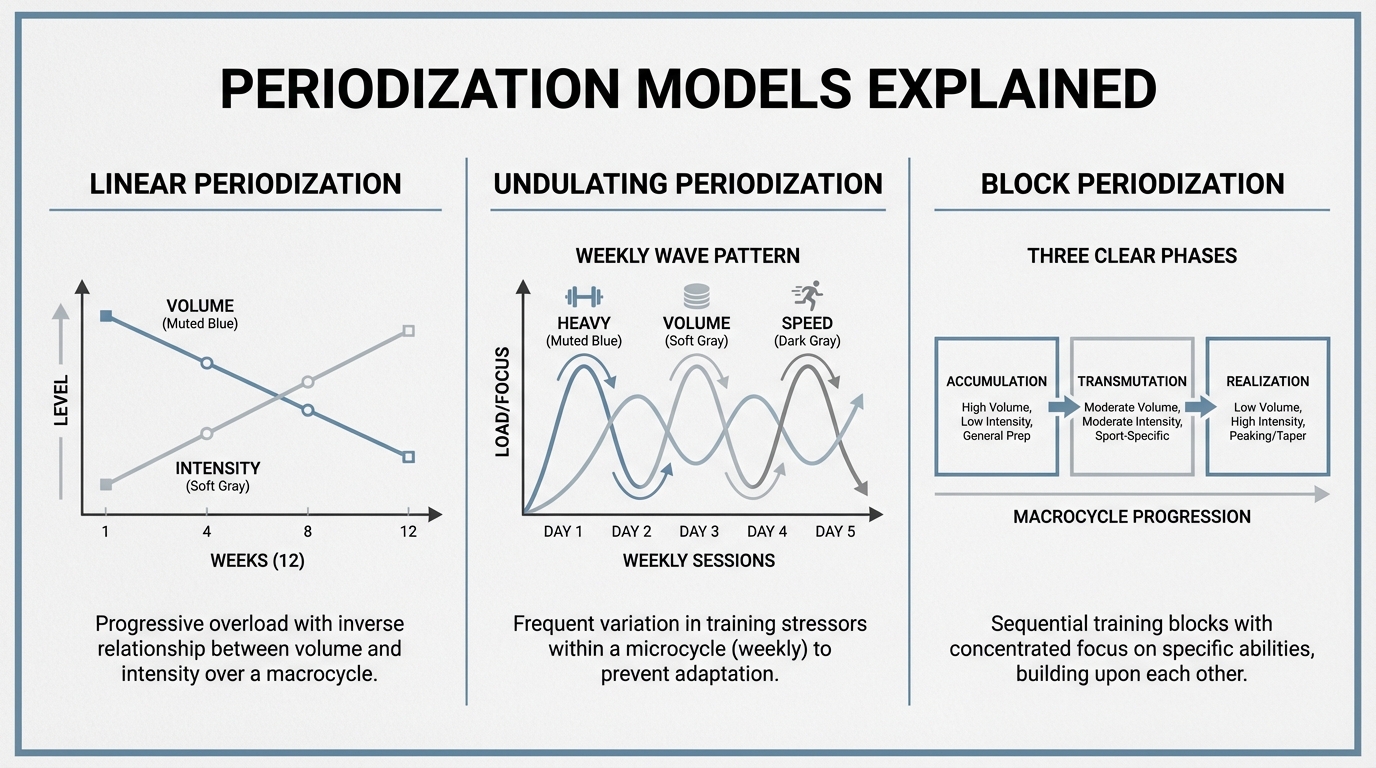
Undulating periodization does the opposite of linear. Instead of doing the same rep range for 4 weeks, you change it every week. Or sometimes every workout.
A typical undulating week: Monday: 3x2 at 90% (heavy, CNS work). Wednesday: 4x8 at 70% (hypertrophy/volume).
Friday: 5x3 at 80% (speed/power). So in one week you hit maximal strength, hypertrophy, and speed. Then next week the percentages and rep ranges shift again.
Why does this matter? Because your nervous system never fully adapts. You're constantly giving it a new challenge.
Monday you're training your nervous system to handle maximal loads. Wednesday you're training work capacity and muscle damage. Friday you're training rate of force development.
You maintain *all* qualities simultaneously rather than building them sequentially.
When Undulating Works Best
Undulating periodization is your friend if: You've trained for 2+ years and your nervous system adapts quickly. You want to maintain multiple qualities (strength, hypertrophy, power) simultaneously. You have 4+ training days per week.
You get bored easily. You compete in a sport where you need multiple qualities (powerlifting, CrossFit, strongman). You have variable recovery.
Here's why that last point matters: on a linear program, if you're tired, you still have to do 4x10. If you skip a day, it messes up the cycle. On undulating, if you're tired, you can do volume work instead of heavy work.
Your body gets stimulated but not crushed. If you skip a day, there's no 'cycle' to mess up. Every day is somewhat independent.
Real World: Undulating in Action
Sarah trained linearly for 18 months. She got strong. But by month 4 of her third cycle, she was burned out.
The predictability that worked at month 1 now felt stale. She switched to undulating. Here's what changed: Before, she'd do 4x10 for a month straight.
Her knees and back would hurt. She'd lose motivation halfway through. Now, she does heavy doubles on Monday (feels powerful), volume reps on Thursday (feels like a pump), and speed work on Saturday (feels fast).
By varying the stimulus, she actually recovers better. Her joints don't take the same pounding every day. Her CNS gets different demands.
After 6 months of undulating, she hit a squat PR she didn't even know was possible. The variety kept her fresh. The simultaneous work on all qualities made her more resilient.
Block Periodization: Focused Phases for Competition
Block periodization is different. Instead of varying weekly, you commit to a 4-week block with ONE specific focus. The Accumulation Block (3-4 weeks): High volume, lower intensity.
3-4 sets x 8-15 reps at 60-75%. Goal: build muscle, work capacity, connective tissue resilience.
The Transmutation Block (3-4 weeks): Moderate volume, higher intensity. 5-8 sets x 3-6 reps at 75-85%. Goal: convert the muscle and work capacity into pure strength.
The Realization Block (1-2 weeks): Very low volume, very high intensity. 1-3 reps at 90%+. Goal: maximize nervous system recruitment and peak your lifts.
Then you deload and start again. Block periodization is used by every serious competitive powerlifter. Why?
Because you can't peak year-round. You build, convert, peak, then recover and rebuild. It's cyclical, strategic, and proven.
When Block Works Best
Block periodization is your friend if: You're competing and need to peak on specific dates. You're advanced (5+ years of consistent training). You have access to a coach or program.
You respond well to focused, single-quality phases. You want maximum strength and don't need variety for motivation. You're willing to sacrifice hypertrophy during peak phases.
Real world: Marcus is a competitive powerlifter competing in 16 weeks. He runs: Weeks 1-4 (Accumulation): 4x10 squats and bench, 5x8 deadlifts.
Focus on work capacity. His joints get stronger, his muscle mass increases. Weeks 5-8 (Transmutation): 4x4 squats and bench, 3x5 deadlifts.
Same movements, higher intensity. His nervous system learns to recruit at higher loads. Weeks 9-12 (Realization): 2x2 squats and bench, 2x3 deadlifts.
He's peaking. Singles some days. His lifts are going up every session.
Weeks 13-16 (Meet Prep): Very light, technical work. He's fresh and ready. He hits all-time PRs at the meet.
Block periodization let him plan his year strategically.
So Which One Should YOU Use?
UNDER 2 YEARS TRAINING: Use Linear. You need the foundation. 12 weeks of linear will give you more strength than 12 weeks of anything else right now.
2-5 YEARS TRAINING, NOT COMPETING: Use Undulating. You've got enough training age to benefit from variety. You'll maintain more qualities and recover better.
2-5 YEARS TRAINING, COMPETING IN 3+ MONTHS: Use Block. You need to peak on a specific date. Plan your training around that.
5+ YEARS TRAINING, CASUAL: Use Undulating or a mix of block/undulating. You know your body. You know what works. Experiment.
5+ YEARS TRAINING, COMPETING: Use Block. Every competitive athlete at the top uses some form of block periodization.
The Hybrid Approach (Used by Smart Coaches)
The reality most gyms won't tell you: elite coaches use hybrids. Off-season might be pure undulating for 8 weeks (variety, maintain all qualities). Then transition to block for 12 weeks leading to competition (build, convert, peak).
Or: run linear for beginners their first year, then shift to undulating year 2, then block by year 3. The progression makes sense. Your nervous system gets more complex demands as you progress.
Pick what fits where you are, not where you want to be.
Bottom Line: Pick Your Model, Commit, Evaluate
Stop overthinking it. Pick one based on your training age and situation. Commit for 12 weeks.
Track your progress. At week 12, evaluate: Did my main lifts go up?
Did I feel good? Did I recover well? Based on that, pick your next model.
This is how you find what works for you. The best periodization model is the one you'll actually follow and can progress on. Go use it.
Choosing Structure With Tsunami Barbell
Linear. Undulating. Block.
All three work — when applied at the right time.
Tsunami Barbell doesn’t lock you into one rigid model. It adapts your training phase based on your performance, recovery, and progression trends.
Early phases may emphasize volume.
Later phases may increase intensity.
Peak phases reduce fatigue and sharpen performance.
Periodization isn’t about picking a label.
It’s about applying structured variation at the right moment — and adjusting when your body stops responding.
Elite coaches do this manually.
Intelligent systems do it continuously.
Structure beats randomness. Adaptation beats stagnation.
Frequently Asked Questions About Periodization Models
Is linear periodization outdated?
No. It’s extremely effective for beginners and those rebuilding a base. Its simplicity is a strength, not a weakness.
Is undulating better than linear?
For intermediate lifters, often yes. Frequent variation helps prevent adaptation and maintains multiple strength qualities simultaneously.
Is block periodization only for competitors?
Mostly. Block models are best when you need to peak for a specific event. Casual lifters often don’t need full block structure year-round.
Can I combine periodization models?
Yes. Many advanced programs blend undulating during off-season and block leading into competition.
How long should I stick with one model?
Commit for at least 8–12 weeks before evaluating results. Changing models every few weeks prevents meaningful adaptation.
What’s the biggest mistake lifters make with periodization?
Switching too early.
They abandon a model before giving it time to work, then blame the program instead of their inconsistenc
Tsunami Barbell
Evidence-based strength coaching and programming for athletes who want real progress.